

Beyond Oil: How the Strait of Hormuz Is Reshaping Global Trade and Supply Chains
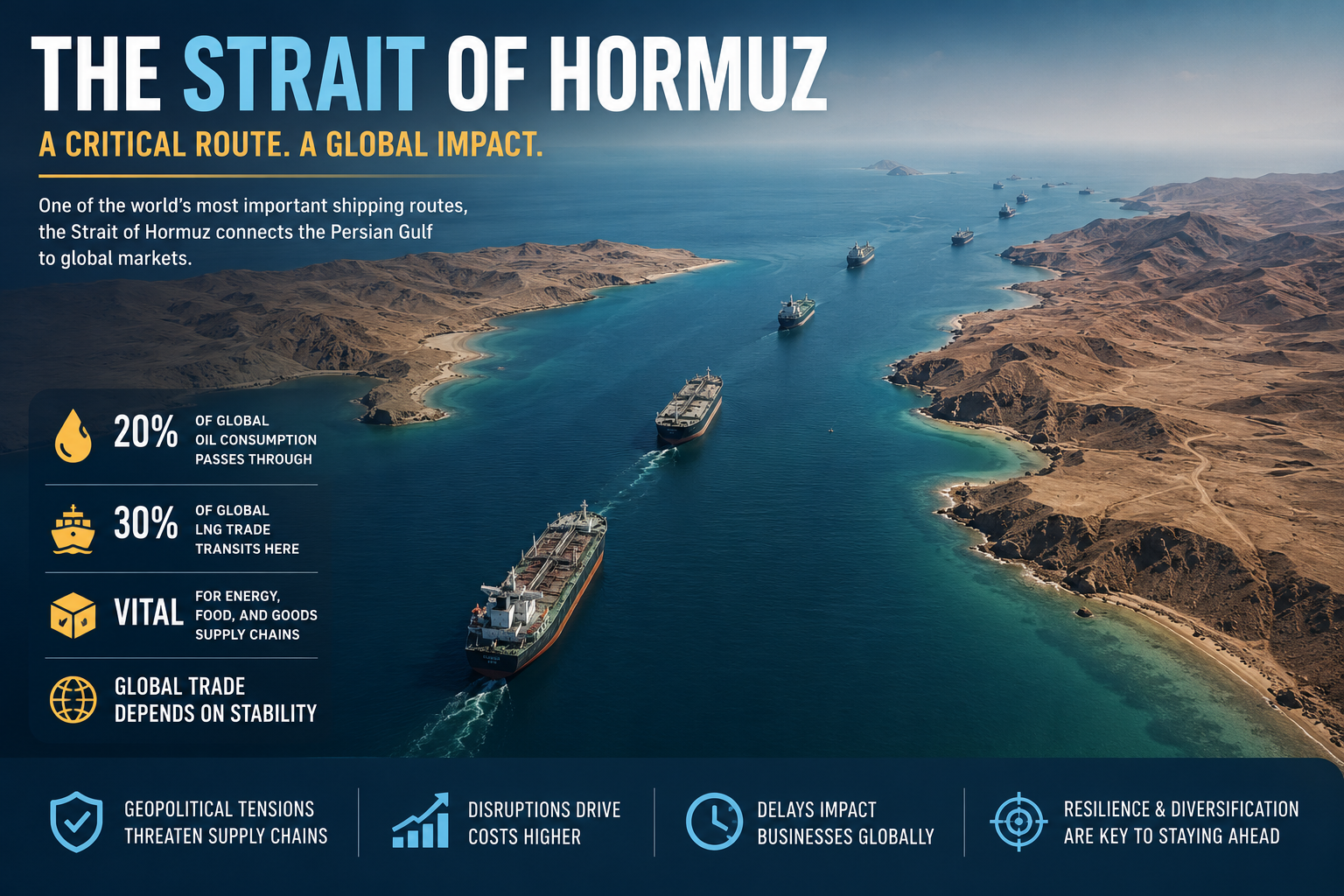
When discussions turn to the Strait of Hormuz, most headlines focus on one thing: oil.
Yet the significance of this narrow stretch of water extends far beyond the global energy market. For businesses involved in agriculture, food manufacturing, commodity trading, and international logistics, the Strait of Hormuz has become one of the world's most important supply chain chokepoints.
Recent geopolitical tensions and disruptions in the region have highlighted just how interconnected global trade has become. Even businesses that never purchase a barrel of oil can still feel the consequences through higher freight costs, longer delivery times, rising insurance premiums, and increasing input prices.
For importers, exporters, manufacturers, and commodity buyers, understanding these risks has become essential.
Why the Strait of Hormuz Matters
Located between the Persian Gulf and the Gulf of Oman, the Strait of Hormuz is one of the busiest maritime trade routes in the world.
Every day, millions of barrels of crude oil, liquefied natural gas (LNG), fertilisers, chemicals, and other raw materials pass through this narrow corridor before reaching international markets. Any disruption, whether temporary or prolonged, has the potential to ripple across global supply chains.
Although the Strait occupies only a small area on the map, its importance to international commerce is enormous.
The Ripple Effect on Global Trade
One of the biggest misconceptions is that disruptions only affect countries in the Middle East.
In reality, the effects travel quickly through global markets.
When shipping routes become uncertain:
Freight costs increase.
Marine insurance premiums rise.
Shipping schedules become less reliable.
Alternative routes become congested.
Businesses face longer lead times.
The result is greater uncertainty throughout international trade.
Agriculture Is More Exposed Than Many Realise
While agriculture may appear disconnected from geopolitical events, the sector depends heavily on stable logistics and affordable production inputs.
One of the biggest concerns is fertiliser.
A significant share of global fertiliser exports, including urea, ammonia and sulphur, moves through or is linked to supply chains that depend on the Strait of Hormuz. When those flows are disrupted, fertiliser prices rise, increasing production costs for farmers around the world.
For producers of cocoa, cashews, coconuts and other agricultural commodities, these higher production costs eventually feed into global pricing.
The impact does not stop on the farm.
Higher fuel prices increase transport costs from farms to processing facilities, ports, and ultimately international buyers.
What Does This Mean for Commodity Markets?
Commodity markets dislike uncertainty.
Periods of geopolitical tension often trigger increased price volatility—not necessarily because supply has disappeared, but because buyers begin preparing for possible disruption.
Businesses may:
Purchase inventory earlier.
Increase stockholding.
Diversify suppliers.
Renegotiate logistics contracts.
Delay purchasing decisions while waiting for market clarity.
These reactions can create additional pressure on supply chains, even when physical shortages are limited.
Why Supply Chain Resilience Is Becoming a Competitive Advantage
The events surrounding the Strait of Hormuz reinforce an important lesson for international trade:
Resilience is becoming just as valuable as price.
Companies that rely on a single supplier, a single shipping route, or a single sourcing strategy are becoming increasingly vulnerable to geopolitical shocks.
Forward-thinking organisations are instead investing in:
Multiple sourcing regions.
Flexible logistics partnerships.
Better demand forecasting.
Strong supplier relationships.
Greater visibility across their supply chains.
The objective is not simply to reduce costs ; itcosts;it is to reduce risk.
What Buyers Should Be Doing Now
For procurement teams and international buyers, this is an opportunity to strengthen sourcing strategies rather than react to market headlines.
Key priorities include:
Reviewing supplier diversification.
Securing reliable long-term sourcing partners.
Building greater flexibility into contracts.
Planning purchases further in advance.
Monitoring geopolitical developments that influence shipping and logistics.
Waiting until disruption occurs often limits available options and increases costs.
Looking Ahead
Although recent diplomatic efforts have reduced some immediate tensions, shipping activity across key regional trade corridors remains below normal levels, and businesses continue to monitor developments closely.
The Strait of Hormuz serves as a reminder that modern supply chains are deeply interconnected.
A disruption in one region can influence commodity prices, agricultural production, freight costs, manufacturing schedules, and consumer prices thousands of miles away.
For businesses operating in international trade, resilience, adaptability, and informed decision-making are no longer optional—they are becoming essential components of long-term success.
Styyer's Perspective
At Styyer, we believe successful commodity sourcing requires more than finding competitive prices.
It requires understanding global markets, anticipating supply chain risks, and building trusted partnerships that can withstand periods of uncertainty.
Whether sourcing cocoa, cashews, coconut products, or other agricultural commodities, businesses that combine market intelligence with reliable execution will be best positioned to navigate an increasingly complex trading environment.
As global trade continues to evolve, staying informed is one of the strongest competitive advantages a business can have.
